
Best CRM Software for Educational Institutes: Convert More Enquiries, Close More Admissions
If you’re an admissions head or educational institute marketer, here’s a number that would shock you: India’s higher education enrollment jumped from 3.42 crore to 4.33 crore between 2014-15 and 2021-22. That’s a humongous jump of 26.5%. It means there are more students, more competition, more enquiries than ever, which are flooding in from more channels than any counsellor can track on a spreadsheet.
And therein lies the real problem. A lack of a system to catch them before they go cold.
The Struggle Is Real
If your counsellors are still juggling Excel sheets, WhatsApp screenshots, and a notebook of “call back tomorrow” reminders, you already know how this ends. A student fills a form on your website, messages you on WhatsApp, calls your front desk, and compares you against three other institutes, all in the same week. Somewhere in that chaos, a genuinely interested student falls through the cracks. And the reason is: nobody followed up in time.
This is what a CRM actually fixes. It puts every enquiry in one place, so every follow-up happens on schedule, and you can finally see where your admission funnel is leaking.
We work with education clients on the marketing side at Socialee. You can bet the CRM conversation comes up in almost every strategy call. So we pulled together what actually matters when picking one, and what Indian institutes are doing differently with the CRMs they’ve already bought.
What to Look for in a CRM Before an Educational Institute Commits to One
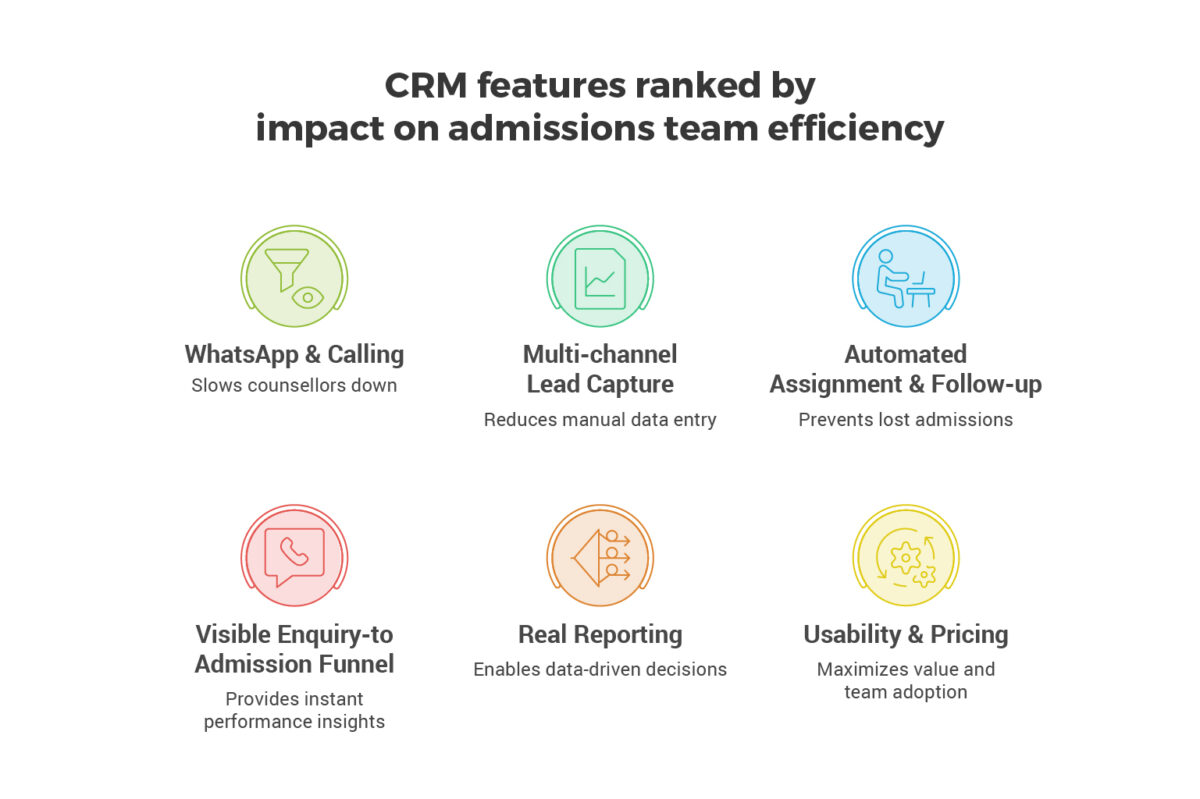
Most CRM comparison articles hand you a feature checklist a mile long. You can skip that. Here’s what actually moves the needle for an admissions team.
1. Multi-channel lead capture
Your enquiries aren’t coming from one place. They’re coming from your website form, Facebook and Google ads, walk-ins, education fairs, referral partners, and WhatsApp. If your CRM can’t pull leads from every one of these into a single record automatically, your team is still doing manual data entry, and manual data entry is where leads die.
2. Automated counsellor assignment and follow-up
The moment a lead comes in, it needs to land with the right counsellor based on program interest, location, or whatever logic fits your institute. Then the CRM should nudge that counsellor with reminders, because “I forgot to call back” is the single most avoidable reason institutes lose admissions.
3. A visible enquiry-to-admission funnel
You should be able to look at a dashboard and instantly know: how many enquiries came in this week, how many are still “in progress,” how many converted, and where exactly people are dropping off. If you can’t answer that in 10 seconds, your CRM (or the way you’re using it) isn’t doing its job.
4. WhatsApp and calling built in
Indian students and parents love WhatsApp. If your CRM doesn’t support it properly, your counsellors will waste time switching between tools. Click-to-call and WhatsApp integration should be basic CRM features.
5. Real reporting with important metrics
Your team needs clarity on enquiry-to-enrollment ratio, average follow-up response time, counsellor-wise performance, and (if you run multiple centres) centre-wise comparisons. Skip any CRM whose “analytics” tab is just a pretty pie chart with no actionable numbers behind it.
6. Pricing that matches how you actually operate
Pricing matters, but you also need to get the most value for your money. Some CRMs charge per user, per month. Others charge per application processed. Sounds like a small detail; it isn’t. If your admission volume spikes every March-June and flattens the rest of the year, a per-application model can become very expensive during your peak season. Ask this question before you sign.
7. Can your team actually run it without a training marathon?
The best CRM on paper is worthless if your counsellors can’t pick it up in a week. Ask for a trial. Watch how long it takes a new counsellor to log a lead and set a follow-up without help. That’s your real usability test.
Top CRM Tools Compared: Admission Pipeline, Lead Tracking & Automation Features
We looked at the CRMs Indian educational institutes actually use, not just the ones with the biggest ad budgets. Here’s how they compare.
CRM | Best For | Standout Feature | Pricing Model | Notable Users |
Meritto (formerly NoPaperForms) | Colleges, universities & admission-heavy institutions with medium-to-high enquiry volume | Admission management built specifically for education, not adapted from a generic sales tool | Historically priced around applications processed, not per seat | Reportedly used by DAU, GIFT IFI, Coursera, PhysicsWallah, Adda247, Lovely Professional University, BITS Pilani |
LeadSquared | Institutes that want a proven, general-purpose CRM with strong marketing automation | Marketing automation built for admission campaigns, plus wide adoption outside education too | Per-user, tiered, published plans have run around ₹1,250 (Lite), ₹2,500 (Pro), and ₹4,500 (Super) per user, per month, billed annually | Reportedly used by upGrad, Amity University, Zell Education |
Kylas | Small-to-mid institutes and coaching centres that want strong features without enterprise pricing | Unlimited-user, flat pricing model with education-specific workflows | Freemium tier, then paid plans starting around ₹12,999/month | Used across education, EdTech and coaching institute segments like iiiEM |
Zoho CRM | Institutes that want deep customization and are comfortable configuring it themselves | Highly flexible; every field, pipeline stage and report can be reshaped around enquiry management and the admission pipeline | Per-user, tiered (general business CRM pricing) | Broad cross-industry base, including education |
ExtraaEdge | Coaching institutes, schools and EdTech brands focused on admission analytics | Multi-step enquiry forms that feed straight into the CRM, plus automated fee reminders and payment gateway integration | Custom pricing; confirm current tiers directly with the vendor | Indian coaching institutes and EdTech brands |
Telecrm | Institutes that want calling, WhatsApp and lead management combined in one simple tool | Calling, WhatsApp and lead management bundled into a single plan, nothing feature-gated | Single flat plan (no feature-gating) | Used by 400+ educational institutions, per the company’s own figures |
A few honest observations from that table:
Meritto vs. LeadSquared is the comparison every institute eventually runs into, and it’s worth understanding the trade-off. LeadSquared is a general marketing automation platform that happens to serve education well, which means it’s flexible but sometimes needs extra configuration to feel education-specific. Meritto was built for education from day one, so the admission workflow feels native. But its historical per-application pricing means your cost can climb fast during a strong admission season. Neither is “wrong.” It depends on whether you value flexibility or out-of-the-box fit more.
Kylas and Telecrm sit in a different bracket entirely, built for institutes that don’t want to pay enterprise prices for features they’ll use maybe 30% of. If your team is small and your admission process is straightforward, don’t over-buy. A ₹75,000/month enterprise CRM makes zero sense for a 5-counsellor coaching institute.
Zoho is the “if you know what you’re doing” option. It can be shaped into almost anything, but that flexibility means someone on your team (or an agency) needs to actually set it up right. Left half-configured, it turns into an expensive glorified spreadsheet.
How Indian Institutes Are Using CRM to Cut Enquiry-to-Admission Drop-off
Buying the CRM is the easy part. Here’s where institutes actually see the drop-off numbers move.
They stop treating “response time” as a soft metric
The institutes seeing real results track one number obsessively: how fast a counsellor responds to a new enquiry. Not by the end of the day within minutes. A prospective student comparing five institutes in one evening isn’t waiting around for a callback tomorrow. CRMs with automated routing and instant notifications exist for exactly this reason, and institutes that actually enforce fast-response as a KPI (not just a feature they paid for) see the biggest jump in conversion.
They map the funnel before automating it
The expensive mistake we see most often: an institute buys a CRM, turns on every automation available, and never actually defines their own enquiry stages first. What does “qualified lead” mean for your institute? At what point does a lead become an “application”? If that isn’t defined clearly before setup, the CRM just automates confusion faster. Institutes that get real value map their funnel stages first: enquiry, contacted, counselled, application started, application submitted, admitted, and only then build automation around it.
They use centre-wise and counsellor-wise reporting to fix the actual bottleneck
Drop-off usually isn’t happening everywhere equally. One centre might be converting at 40% while another is stuck at 12% with the same lead quality. That gap is where the real fix is. You can only find it if your CRM reports at the centre and counsellor level, not just as one blended number for the whole institute.
They connect WhatsApp as a primary channel, not a backup
Parents in India are far more likely to open a WhatsApp message than answer a call from an unknown number or check email. Institutes running fee reminders, document requests, and admission status updates through WhatsApp inside the CRM are seeing noticeably fewer drop-offs.
They review the funnel weekly, not at the end of the admission season
This sounds obvious, but it’s the piece most institutes skip. A CRM’s reporting is only useful if someone is actually looking at it every week and asking “where are we losing people, and why?” Institutes that build this into a standing weekly review catch drop-off patterns early enough to fix them.
Which CRM Should You Actually Pick?
If your admission volume is high and you want a platform purpose-built for education from the ground up, Meritto or LeadSquared are the two worth demoing first. Just go in with clarity about their pricing models. If you’re a smaller institute or coaching centre that needs strong fundamentals without enterprise pricing, Kylas or Telecrm will get you there faster and cheaper. And if you already have technical support in-house and want maximum flexibility, Zoho is worth the setup effort.
Whichever CRM you land on, the software is only half the equation. The other half is capturing the right leads in the first place, with campaigns that bring in students who actually convert. This is where most institutes lose more admissions than any CRM gap ever will.
That’s the part Socialee works on with higher education institutes every day: building the admission marketing strategy that feeds your CRM with leads worth chasing. If you’re evaluating a CRM and want a second opinion on whether your enquiry-to-admission funnel is actually broken upstream (marketing) or downstream (follow-up), talk to our higher education marketing team.