
Imagine having the best quarter of your business. You did everything right, and you felt confident that you’ve finally cracked the code. But when you tally everything up at the end of the quarter, you realise you’re actually losing money. Frustrating, isn’t it? It happens to D2C brands more often than founders like to admit. Sales climb, the team celebrates, and then the bank balance tells a completely different story. The reason is almost always the same: nobody was watching margin while the top line grew.
This guide breaks down what “good” ecommerce profit margin actually means, accounting gross margin and net margin, how those numbers differ across D2C, dropshipping, marketplaces, and subscription models, and the exact formulas to calculate where you stand.
Gross Margin vs. Net Margin Explained in Plain Terms
People often use gross margin and net margin as if they mean the same thing. They don’t. And confusing the two can lead to bad business decisions. It is one of the reasons founders sometimes think their business is doing well when they are actually losing money. Here is gross margin vs. net margin explained in plain terms.
Gross margin is the money left after you remove the direct cost of making or buying your product. It helps you understand whether your product is making enough money before you consider other business expenses.
Total Product Cost = Cost of Goods Sold (COGS) + Packaging Cost
Gross Margin (₹) = Selling Price − Product Cost
Gross Margin (%) = Gross Margin ÷ Selling Price
A 60% gross margin may look great on paper. But it does not tell you whether your business is actually profitable. You still need to pay for shipping, platform fees, marketing, returns, and other business costs.
Net margin is the money you have left after paying for almost everything involved in selling the product. This includes fees, advertising, returns, software, customer support, and other expenses. It is the number that tells you whether you can pay yourself, reinvest in the business, or handle a slow month.
Net Profit per Unit = Contribution Margin 2 − Other Costs
Net Profit Margin (%) = Net Profit per Unit ÷ Selling Price
Between gross margin and net margin, there are several costs that can change your final profit. Here is the full calculation, step by step:
Net Shipping Cost = Shipping Cost − Shipping Charged to Customer
Total Fulfillment Cost = Net Shipping Cost + Warehousing/Storage Cost + Pick & Pack Cost
Total Platform Fees = Platform Commission (₹) + Payment Gateway Fee (₹) (Platform Commission = Selling Price × Commission Rate; Payment Gateway Fee = Selling Price × Gateway Rate)
Contribution Margin 1 = Gross Margin − Fulfillment Cost − Platform Fees Return Cost = Selling Price × Return Rate (%)
Contribution Margin 2 = Contribution Margin 1 − Marketing Cost − Return Cost
Total Other Costs = Customer Support Cost + Technology/Software Cost + Miscellaneous Costs
Run your numbers through this calculation once, and you may be surprised. A business with a 55% gross margin can end up with a single-digit net margin after all the other costs are included. That difference is normal. What matters is knowing how big that gap is before you increase your ad spend or start scaling.
What Counts as a “Good” Net Margin in 2026?
There is no single net margin that works for every business. However, these ranges can give you a useful starting point. A net margin above 15-20% is generally considered healthy, while 10-15% can be acceptable. Anything below 10% deserves a closer look.
IF Net Margin ≥ 20% → Healthy
IF Net Margin 10–20% → Marginal / Acceptable
IF Net Margin 5–10% → Weak
IF Net Margin < 5% → Unsustainable
There is one important exception. A brand may choose to operate on a lower margin for a short period while spending more on customer acquisition and growth. That can be a planned decision. The real problem is when your margin is low without you knowing why.
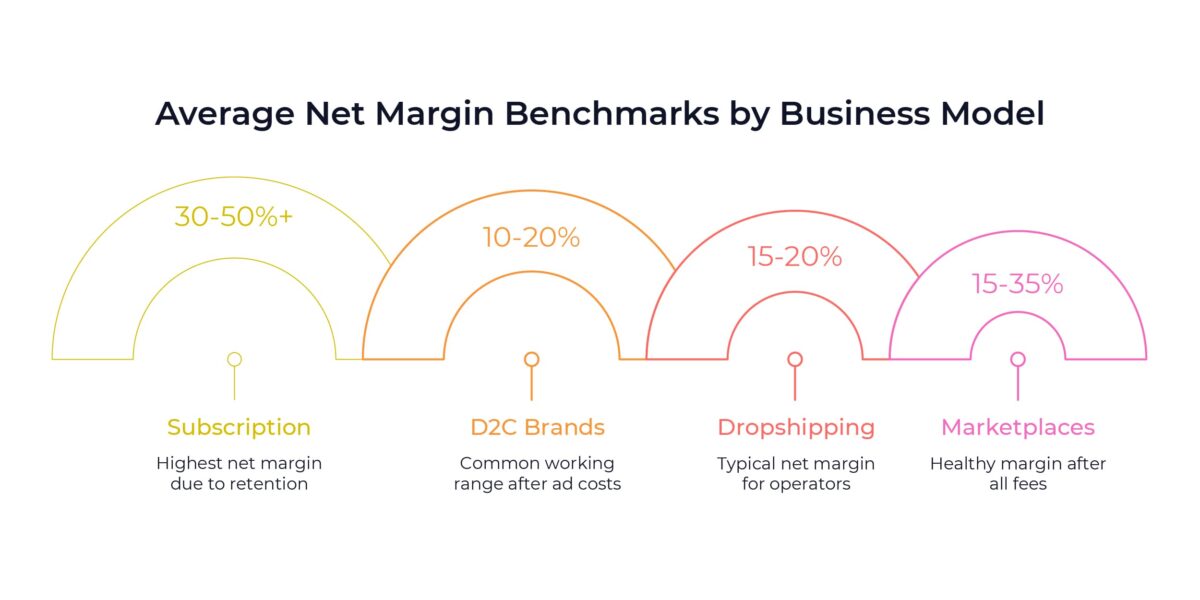
Average Margin Benchmarks by Business Model
A “good” ecommerce profit margin can look very different depending on your business model. Here’s a simple look at where different models tend to stand.
D2C brands
Most direct-to-consumer brands have gross margins somewhere around 55-70%. But this number can drop quickly once you include customer acquisition costs, returns, shipping, platform fees, and other expenses. For many D2C brands, the bigger focus should not just be on gross margin. Contribution margin is also important because it shows how much money is left after the costs directly linked to selling the product.
A realistic target is around 25-45% net margin for a strong D2C business, while 10-20% is a more common working range after advertising and returns are included. Below 5%, even one bad month can put serious pressure on your business.
Dropshipping
Dropshipping is still considered a high-margin business because the product can have a 40-60%+ gross margin before advertising costs. But the actual profit can look very different. Typical dropshipping businesses may see net margins around 10-30%, with many businesses sitting closer to 15-20%. New businesses can easily fall below 10% once advertising and other costs are added. The main challenge is that you have less control over product and shipping costs. A small increase in supplier or fulfilment costs can quickly reduce your profit.
Marketplaces (Amazon, Flipkart, and similar)
Selling through marketplaces like Amazon or Flipkart gives you access to a large customer base, but you also have to pay platform fees and deal with marketplace-specific costs. For Indian marketplace sellers, a healthy margin can generally fall in the 15-35% range after product costs and fees. Fashion businesses may be closer to 20-35%, while electronics can be much lower, sometimes around 5-15%, because of price competition and returns. The platform you sell on also matters. Different fee structures can make a noticeable difference to your final profit.
Pricing Status Check
IF Margin % ≥ Target Margin % → “Good”
ELSE → “Low – reprice or cut costs”
Check this for every SKU before you list it. Don’t wait until the end of the quarter to find out that a product isn’t making enough money.
Subscription
Subscription businesses can have an advantage because customers continue to generate revenue after the first purchase. You don’t have to spend money acquiring the same customer every time they buy. This can help subscription businesses reach 30-50%+ net margins in some cases. But there is a catch: customers need to stay subscribed. If your churn is high, you lose the benefit of recurring revenue and may end up spending heavily to replace customers who leave. A subscription business with high churn can start looking financially similar to a regular D2C business, but with more pressure on cash flow.
Why Revenue Growth Without Margin Tracking Kills D2C Brands
This is where many founders learn the hard way. Revenue growth feels like progress. It appears on your dashboard, investors ask about it, and everyone feels good when the number keeps going up. But higher revenue does not always mean higher profit.
Here’s what can happen: you increase your ad spend to hit a growth target. Sales go up, and the team celebrates. But if your contribution margin was already low, you may simply be selling more products while making very little money on each one. At the same time, growth can bring new costs. You may need a bigger warehouse, more customer support staff, more software, or more operations support. So your revenue goes up, but your costs go up too.
Break-Even Units = Fixed Costs ÷ Net Profit per Unit
Monthly Profit = Net Profit per Unit × Monthly Units Sold
If your Net Profit per Unit is very small, you need to sell a lot more products to cover your fixed costs. This can make your break-even point much harder to reach.
The solution is simple: track your net margin as closely as you track revenue. Don’t check it only once a quarter. Check it regularly. Look at it by SKU and not just for the entire store. If your revenue is going up but your margin is going down, find out why before you increase your marketing spend further.
How to Price for the Margin You Actually Want
Many stores decide their price by looking at competitors and choosing a number that feels reasonable. They then calculate their margin later. A better approach is to start with the margin you want and work backwards.
Target-Margin Pricing
Selling Price = (Product Cost + Fulfillment + Marketing + Other Costs) ÷ (1 − Target Margin % − Variable Fee %)
(Variable Fee % = Platform Commission % + Payment Gateway %)
First, decide how much profit you want to make from each sale. Then use the formula to understand what your selling price should be. If the price is too high for your market, that’s useful information too. It may mean you need to reduce costs, change the product, improve its value, or accept a lower margin as a conscious business decision.
The important thing is to make that decision before you start scaling, not after.
Check Your Own Numbers Before You Scale
Industry benchmarks are useful, but they can only tell you so much. Your actual profit depends on your product category, return rate, shipping costs, marketing spend, platform fees, and many other factors. The best way to understand your business is to run your own numbers through the full calculation above.
Run your numbers through our free ecommerce margin calculator. It includes the key costs and formulas covered in this guide, so you can see where your margin is going and understand your actual profitability before you spend more on growth.