
The truth about discounts in India: It’s not about the price drop. It’s about shifting the mental bucket.
The Biggest Mistake D2C Brands Make
Here’s what most brands get wrong: they think customers buy rationally.
They don’t.
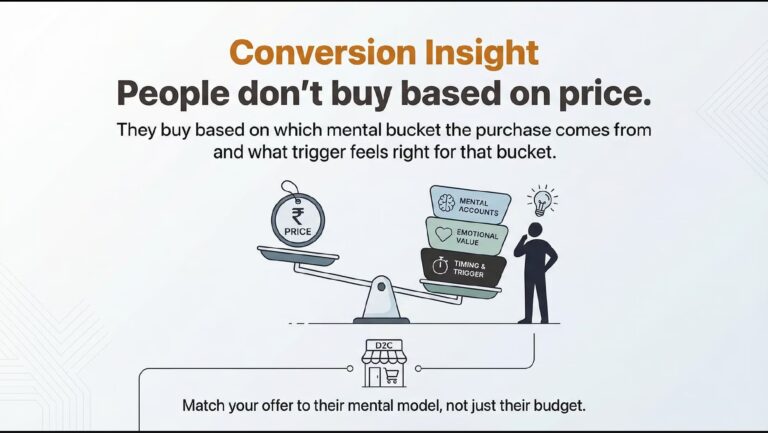
People buy from mental buckets—invisible categories in their minds where each rupee behaves differently.
This isn’t guesswork. It’s based on Mental Accounting, a behavioral economics principle that explains why the same ₹200 can feel “wasteful” in one context and “smart” in another.
And if you’re running performance marketing campaigns without understanding these buckets? You’re leaving conversions and revenue, on the table.
How Mental Accounting Works in India
We don’t see money as one pool. We split it into invisible categories:
Salary money → Spent carefully
UPI cashback → Spent freely
Discounts → Spent smartly
COD → Spent safely
Credit cards → Spent now,Pay later (future me will handle it)
Reward points → Spent guilt-free
Same rupee. Completely different behavior.
This is why your flat 20% off might not work—but a ₹200 cashback offer does.
Different Products, Different Buckets
Here’s where it gets strategic for brands.
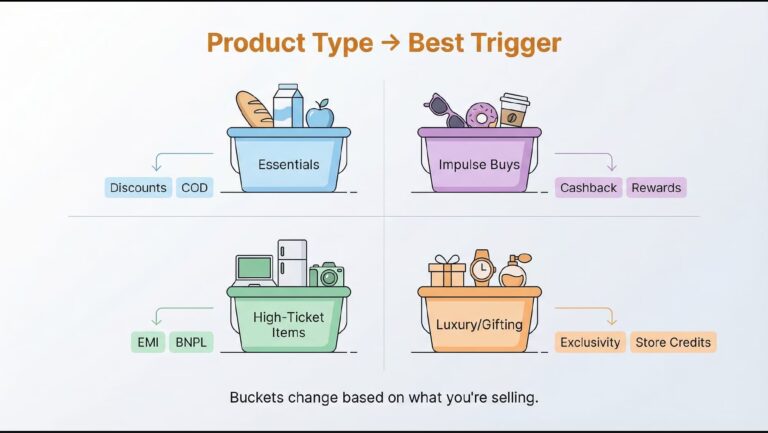
Different products activate different mental buckets:
Essentials (groceries, personal care)
✅ Discounts
✅ COD
✅ Low-entry offers
Impulse Buys (fashion, gadgets, accessories)
✅ Cashback
✅ Wallet credits
✅ Limited-time offers
High-Ticket Items (electronics, furniture)
✅ EMI
✅ Buy Now Pay Later
✅ Bundle deals
Luxury Products (premium fashion, beauty, experiences)
✅ Exclusivity
✅ Store credits
✅ Early access
❌ Not discounts (discounts actually hurt perceived value here)
When you’re planning your digital marketing strategy, matching your offer to the right bucket is just as important as targeting the right audience.
Your Customer Type Matters More Than You Think
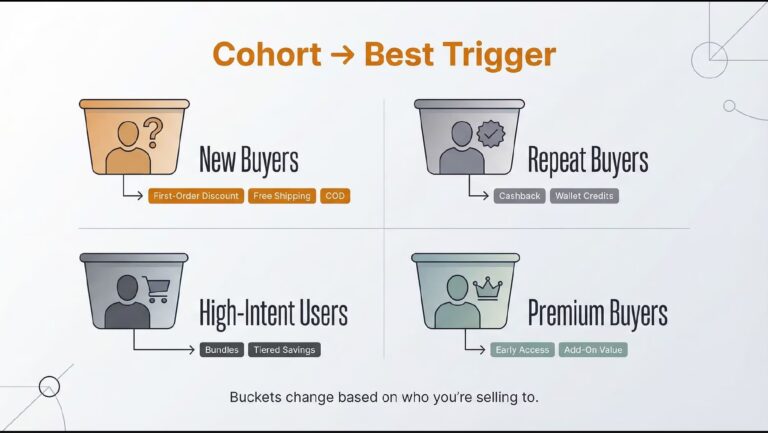
The same offer won’t work for everyone. Here’s how to segment:
New Buyers (Building Trust)
They’re nervous. They need safety signals.
What works:
→ Discounts
→ COD
→ Free shipping
→ Easy returns
Example offer: “First Order? Get 15% off + Free Delivery”
Repeat Buyers (Rewarding Loyalty)
They already trust you. Now they want to feel valued.
What works:
→ Cashback
→ Wallet balance
→ Exclusive member pricing
Example offer: “Get ₹200 Cashback in Your Wallet”
High-Intent Shoppers (Looking for Justification)
They’re ready to buy—they just need a reason to buy NOW.
What works:
→ Bundles
→ Tiered savings (“Spend ₹2000, Save ₹300”)
→ Limited stock alerts
Example offer: “Buy 2, Get 20% Off. Ends Tonight!”
Premium Buyers (Status-Driven)
They don’t want discounts. They want recognition and access.
What works:
→ Early access to sales
→ Invite-only products
→ Add-on value (gift wrapping, personalized notes)
Example offer: “VIP Early Access: Shop the Sale 24 Hours Before Everyone Else”
This segmentation strategy is critical when you’re running social media marketing campaigns or managing paid ad campaigns on Google and Meta.
Why Discounting Actually Works in India
Let’s be clear: discounts work.
But not because the price dropped.
They work because the mental bucket shifted.
Here’s what’s really happening:
Offer Type | Bucket Shift | Customer Feels |
₹200 off | “Loss bucket” → “Smart decision bucket” | “I saved money” |
Cashback | “Expense bucket” → “Free money bucket” | “I can spend this guilt-free” |
Store credits | “New expense” → “Already paid bucket” | “I might as well use it” |
EMI | “Big expense” → “Manageable bucket” | “I can afford this” |
People don’t buy based on price.
They buy based on how the price feels.
The Framework: How to Choose the Right Offer
Before you create your next discount campaign, stop asking:
“How much discount should I give?”
Instead, ask:
“For THIS product and THIS customer cohort, which bucket creates the quickest YES?”
Here’s a simple decision framework:
Step 1: Identify Your Product Type
Is it essential, impulse, high-ticket, or luxury?
Step 2: Know Your Audience Segment
Are they new, repeat, high-intent, or premium buyers?
Step 3: Match to the Right Bucket
Use the tables above to pick the offer type that shifts the right bucket.
Step 4: Test and Optimize
At Socialee, we’ve used this exact approach for e-commerce brands, FMCG companies, and mobile apps to improve conversion rates by 20-40%.
Real-World Application: Examples That Work
Let’s make this practical.
Example 1: Fashion Brand (Impulse Buy)
Audience: Repeat buyers
Offer: “Get ₹300 Cashback in Your Wallet”
Why it works: Repeat buyers see wallet money as “free spend”—they’re much more likely to return and use it.
Example 2: Electronics Store (High-Ticket)
Audience: High-intent shoppers
Offer: “No Cost EMI for 6 Months”
Why it works: Moves the purchase from “expensive” bucket to “manageable” bucket.
Example 3: Premium Skincare (Luxury)
Audience: Premium buyers
Offer: “Early Access: Shop Before Launch + Free Gift”
Why it works: No discount. Pure exclusivity. Premium buyers feel special, not cheap.
Example 4: Grocery Delivery (Essential)
Audience: New buyers
Offer: “First 3 Orders: Flat ₹100 Off + Free Delivery”
Why it works: Builds trust with safety signals (discount + COD/free delivery).
How Socialee Can Help You Shift the Bucket
Understanding mental accounting is one thing. Executing it across channels is another.
At Socialee, we’ve been helping D2C brands design ROI-driven campaigns since 2014. Here’s how we apply this:
✅ Performance Marketing: We structure your paid ad campaigns around the right mental buckets—matching offers to audience intent.
✅ Social Media Strategy: Your social content should reinforce these buckets. We craft messaging that frames offers the right way.
✅ Conversion Rate Optimization: We test different offer types, messaging, and placements to find what drives conversions for YOUR product and YOUR audience.
✅ Data-Driven Insights: We track not just conversions, but why customers convert—helping you refine your offers over time.
Whether you’re in FMCG, SaaS, or healthcare, this framework applies.
Key Takeaways
→ People don’t buy rationally. They buy from mental buckets.
→ The same rupee behaves differently depending on its source (salary vs. cashback vs. credit).
→ Different products (essential, impulse, high-ticket, luxury) activate different buckets.
→ Different customer types (new, repeat, high-intent, premium) respond to different offers.
→ Discounting works in India—not because of price drops, but because of bucket shifts.
→ Before creating an offer, ask: “Which bucket creates the quickest YES?”
Final Thought
Your next campaign shouldn’t start with:
“Let’s give 20% off.”
It should start with:
“For this product and this customer, which bucket do we need to shift?”
Shift the bucket. Shift the sale.
Want to build campaigns that actually convert?
Let’s talk. Get in touch with Socialee and let’s design your next performance marketing strategy around what really drives behavior.