
Most brands treat digital, print, radio, and outdoor as separate campaigns.
They run Facebook ads through one agency, book newspaper spots through another, and handle outdoor through a third. The result? Fragmented messaging, duplicated reach, and wasted budgets.
An integrated media plan fixes this. It coordinates all channels, digital, traditional, and experiential, into one strategy where each medium reinforces the others.
At Socialee, we’ve built integrated campaigns for clients like Zydus Hospitals (combining digital performance with local outdoor for OPD marketing) and Sterling Accuris (mixing app install campaigns with healthcare publication placements). This guide shows you how to plan across all media channels.
What Is Integrated Media Planning?
Integrated media planning is budget allocation across both digital and traditional channels, designed to maximize reach and frequency while controlling for audience overlap.
It answers four questions:
- Which channels reach your target audience most efficiently?
- How do you prevent wasting money on duplicated reach?
- What’s the right budget split between awareness (traditional) and conversion (digital)?
- How do you measure impact across channels that don’t share tracking?
The Full Media Mix: All Channels Explained
Digital Channels (Performance-Driven)
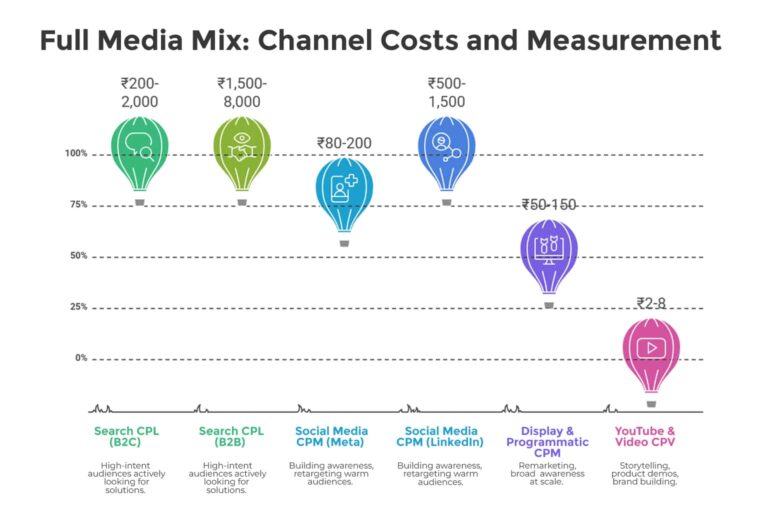
Search (Google Ads)
Best for: High-intent audiences actively looking for solutions
Typical CPL: ₹200-2,000 (B2C), ₹1,500-8,000 (B2B)
Measurement: Direct attribution via conversion tracking
Social Media (Meta, LinkedIn, Twitter)
Best for: Building awareness, retargeting warm audiences
Typical CPM: ₹80-200 (Meta), ₹500-1,500 (LinkedIn)
Measurement: Platform analytics, UTM tracking
Display & Programmatic
Best for: Remarketing, broad awareness at scale
Typical CPM: ₹50-150
Measurement: View-through conversions, brand lift studies
YouTube & Video
Best for: Storytelling, product demos, brand building
Typical CPV: ₹2-8
Measurement: View rate, engagement, traffic lift
Traditional Channels (Reach & Credibility)
Print (Newspapers & Magazines)
Best for: Establishing credibility, reaching older demographics (45+)
Typical Cost: ₹50,000-15 lakhs per full-page ad (depends on publication)
Measurement: Coupon codes, dedicated landing pages, brand recall surveys
Television
Best for: Mass awareness, emotional storytelling
Typical Cost: ₹50,000-50 lakhs per 10-sec spot (depends on channel, time slot)
Measurement: GRP (Gross Rating Points), brand lift, website traffic spikes
Radio
Best for: Local targeting, high frequency at lower cost
Typical Cost: ₹5,000-1 lakh per 10-sec spot (city-specific)
Measurement: Promo codes, call tracking, foot traffic analysis
Outdoor (Hoardings, Transit, Kiosks)
Best for: Location-based visibility, persistent presence
Typical Cost: ₹30,000-10 lakhs per month per site
Measurement: Foot traffic studies, geo-targeted digital lift
Experiential & Hybrid
Events & Activations
Best for: Direct engagement, product trials, community building
Typical Cost: ₹2 lakhs-50 lakhs per event
Measurement: Attendance, lead generation, social media amplification
Influencer Marketing
Best for: Trust-building through third-party endorsement
Typical Cost: ₹10,000-50 lakhs per campaign (depends on influencer tier)
Measurement: Engagement rate, tracked links, promo code usage
The Core Framework: How to Allocate Budget
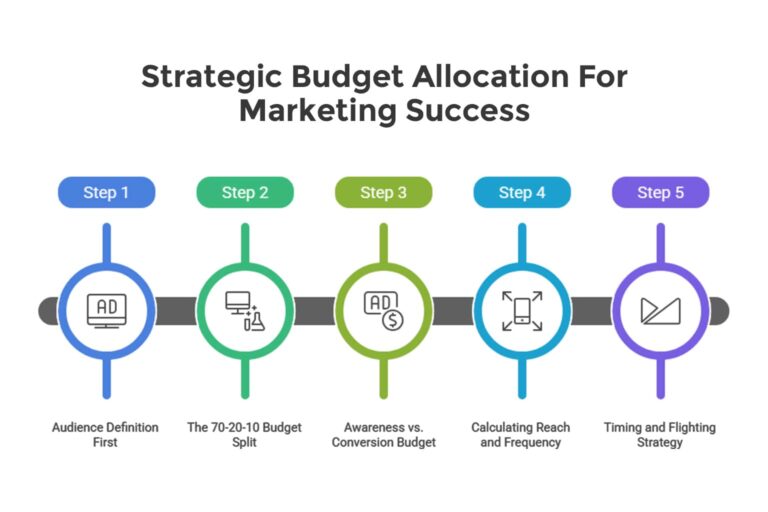
Step 1: Audience Definition First
Before allocating a single rupee, map your target audience:
Demographics: Age, gender, income, location
Media Consumption: Where do they spend time? News apps or newspapers? Instagram or TV?
Purchase Behaviour: Impulse or considered? Online or offline?
Example from our work with DA-IICT (education): Target audience is 17-19 year olds and their parents. Students are on Instagram and YouTube. Parents read newspapers and watch regional news. The media plan includes both.
Step 2: The 70-20-10 Budget Split
This is a starting framework. Adjust based on your category.
70% – Primary Channel (Where Your Audience Lives)
B2C impulse products → Social media
B2B enterprise → LinkedIn + industry publications – Local services → Google Search + outdoor + radio – Mass consumer → TV + digital video
20% – Secondary Channel (Support & Retargeting)
If primary is digital → Add traditional for credibility – If primary is traditional → Add digital for targeting and tracking – Always include remarketing regardless of primary channel
10% – Experimental/Test Channels
New platforms (e.g., influencer marketing if you haven’t tried it)
Niche publications or podcasts
Regional channels you haven’t tested
For Zydus Hospitals’ international patient marketing, we used: 60% digital (Google + Meta for precise targeting), 25% healthcare publications in target countries, 15% airport outdoor in key cities.
Step 3: Awareness vs. Conversion Budget
Awareness-Focused (70% awareness, 30% conversion):
New brand launches
Category creation
Brand repositioning
Use: TV, outdoor, display, social reach campaigns
Conversion-Focused (30% awareness, 70% conversion):
Established brands with strong recall
Performance marketing mode
Lead generation priority
Use: Search, conversion campaigns, remarketing
Balanced (50-50):
Growing brands
Seasonal campaigns
Most B2C and B2B scenarios
Use: Mix of both
Step 4: Calculating Reach and Frequency
The biggest mistake in integrated planning: ignoring audience overlap.
If you run TV, newspaper ads, and Facebook simultaneously in the same city, you’re likely reaching the same people 3+ times while missing others entirely.
Formula:
Reach: Unique people who see your message at least once
Frequency: Average number of times each person sees it
GRP (Gross Rating Points): Reach × Frequency
Optimal frequency by objective:
Brand awareness: 3-5 exposures
Consideration: 5-7 exposures
Direct response: 7-10 exposures
How to calculate overlap:
Use media planning tools or these rough estimates:
TV + Newspaper: 40-50% overlap (same mass audience)
Digital + Print: 20-30% overlap
Outdoor + Digital: 15-25% overlap
Adjust budgets to maintain desired frequency without oversaturation.
Step 5: Timing and Flighting Strategy
Continuous: Steady spend throughout the year
Best for: Evergreen products, sustained lead generation
Example: Healthcare services, education programs
Pulsing: Continuous base + periodic bursts
Best for: Seasonal spikes with year-round demand
Example: Real estate (continuous search + festival season outdoor)
Flighting: Concentrated spend in specific periods, off completely in others
Best for: Highly seasonal products
Example: Tax filing services (Jan-March), admissions (peak months only)
Channel-Specific Budget Allocation Guidelines
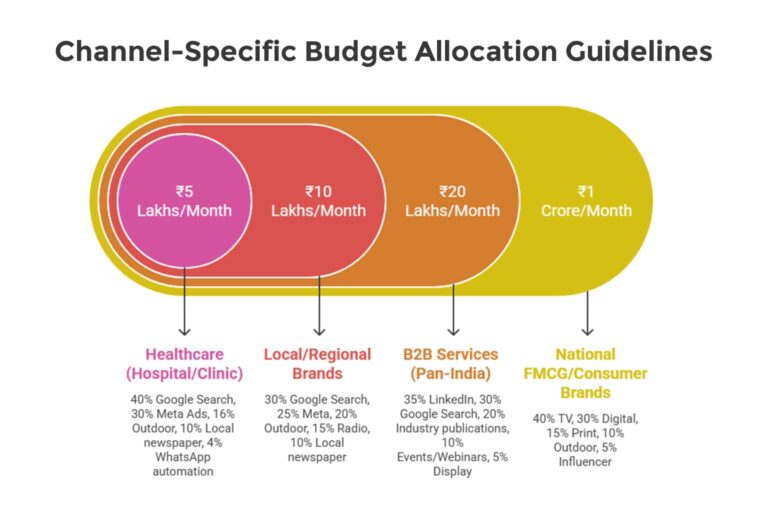
For Local/Regional Brands (Single City or State)
Sample Budget: ₹10 Lakhs/Month
- Google Search: ₹3 lakhs (30%) – Capture local intent
- Meta (FB/Insta): ₹2.5 lakhs (25%) – Awareness + retargeting
- Outdoor (key locations): ₹2 lakhs (20%) – Visibility at high-traffic points
- Radio (morning/evening slots): ₹1.5 lakhs (15%) – Commuter reach
- Local newspaper: ₹1 lakh (10%) – Credibility in community
Why this works: Search captures immediate intent. Social builds awareness. Outdoor + radio create omnipresence. Print adds legitimacy.
For National FMCG/Consumer Brands
Sample Budget: ₹1 Crore/Month
- TV (prime time, select channels): ₹40 lakhs (40%) – Mass reach
- Digital (YouTube + Meta): ₹30 lakhs (30%) – Younger demographics
- Print (national dailies): ₹15 lakhs (15%) – Credibility
- Outdoor (metros): ₹10 lakhs (10%) – Urban visibility
- Influencer marketing: ₹5 lakhs (5%) – Social proof
For B2B Services (Pan-India)
Sample Budget: ₹20 Lakhs/Month
- LinkedIn Ads: ₹7 lakhs (35%) – Decision-maker targeting
- Google Search: ₹6 lakhs (30%) – Intent-based leads
- Industry publications: ₹4 lakhs (20%) – Trade magazines, newsletters
- Events/Webinars: ₹2 lakhs (10%) – Direct engagement
- Display (programmatic): ₹1 lakh (5%) – Remarketing
For Healthcare (Hospital/Clinic)
Sample Budget: ₹5 Lakhs/Month
Based on our work with Zydus and Sterling:
- Google Search (local): ₹2 lakhs (40%) – “Best hospital near me” queries
- Meta Ads: ₹1.5 lakhs (30%) – Health awareness + retargeting
- Outdoor (near hospital): ₹80,000 (16%) – Location visibility
- Local newspaper: ₹50,000 (10%) – Health columns, credibility
- WhatsApp automation: ₹20,000 (4%) – Lead nurturing
Measurement: The Integrated Tracking Framework
Traditional channels don’t have pixel tracking. Here’s how to measure them:
- Unique URLs (e.g., yoursite.com/timesofindia)
- Promo codes specific to each publication
- Dedicated phone numbers with call tracking
- QR codes linking to tracked landing pages
Radio
- Time-stamped web traffic spikes (check analytics during ad slots)
- Unique promo codes mentioned in the ad
- Call tracking numbers
- Brand search volume lift
Outdoor
- Geo-fenced digital campaigns (retarget people near hoarding locations)
- Foot traffic analysis (if near your location)
- QR codes with tracking
- Brand search lift in specific areas
TV
- Web traffic analysis (spikes during/after ad slots)
- Brand search volume increase
- App download spikes
- Toll-free number with source tracking
The Attribution Model
Use Multi-Touch Attribution if you have the budget and tools. Otherwise, use these simpler methods:
First-Touch: Credit the first channel that brought awareness
Last-Touch: Credit the final touchpoint before conversion
Linear: Equal credit to all touchpoints
Time-Decay: More credit to recent touchpoints
For most brands, Last-Touch with assisted conversions is practical: – Primary credit to the converting channel – Note which other channels appeared in the customer journey
Common Mistakes to Avoid
Mistake 1: Digital-Only Tunnel Vision
If your audience is 40+, traditional media still outperforms digital for reach. Ignoring TV, print, or radio can limit your ceiling.
Mistake 2: Forgetting About Geography
A national TV campaign costs crores but might waste 70% of the budget if your product is available only in 5 cities. Regional channels + digital geo-targeting would be smarter.
Mistake 3: No Creative Consistency
Your newspaper ad, Facebook creative, and outdoor hoarding should look like they’re from the same brand. Inconsistent messaging confuses people and dilutes impact.
Mistake 4: Ignoring Frequency Caps
Showing the same person your ad 20 times in a week on multiple channels creates annoyance, not conversions. Cap frequency across channels.
Mistake 5: Equal Budget Across All Months
Unless your demand is perfectly flat (it’s not), seasonal allocation beats even distribution. Spend more during high-intent periods.
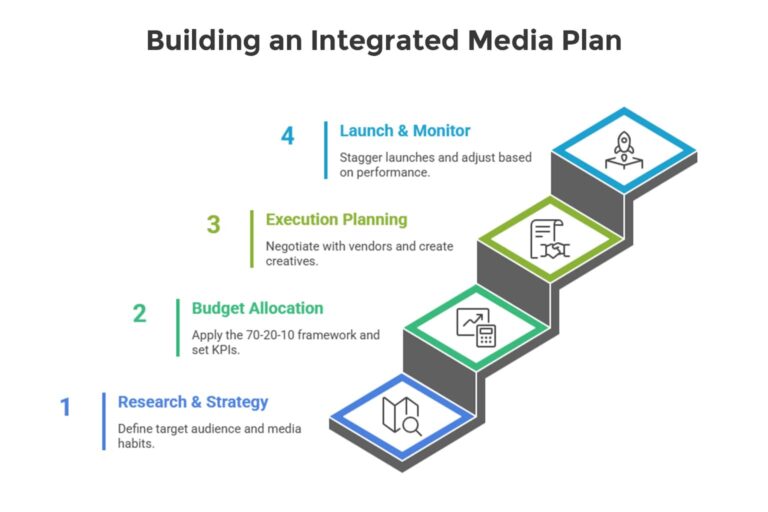
How to Build Your Integrated Media Plan
Week 1: Research and Strategy
- Define target audience with precision
- Map their media consumption habits
- Identify conversion path (online? offline? both?)
- Research channel costs and benchmarks
Week 2: Budget Allocation
- Apply the 70-20-10 framework
- Calculate reach and frequency targets
- Account for audience overlap
- Set KPIs per channel
Week 3: Execution Planning
- Negotiate with media vendors
- Create channel-specific creatives (consistent messaging, format-optimized)
- Set up tracking mechanisms
- Build attribution framework
Week 4: Launch and Monitor
- Stagger launches if testing (don’t launch everything on Day 1)
- Monitor performance daily for digital, weekly for traditional
- Adjust budgets based on early performance
- Run mid-campaign optimizations
The Socialee Approach to Integrated Planning
Every client we work with gets a channel-agnostic strategy. We don’t default to “digital only” because we’re a digital agency. If outdoor makes sense, we recommend it. If radio works better than Meta, we say so.
For Sterling Accuris’ app launch, we combined app install campaigns (digital) with doctor outreach (direct) and healthcare publication placements (print). The integrated approach delivered 3x more installs than digital-only would have.
For Amity University Online, we mix performance marketing (search + social) with education fair presence (experiential) and targeted print in Tier 2 cities where digital penetration is lower.
The principle: Start with the audience. Let them dictate the channel mix, not the other way around.
Final Thoughts
Integrated media planning is harder than single-channel marketing. It requires coordination, measurement discipline, and the humility to use channels outside your comfort zone.
But when done right, it creates omnipresence. Your audience sees you everywhere — on their commute (radio), at traffic signals (outdoor), in their Instagram feed (digital), and in the newspaper they read (print). That compounding effect builds brands faster than any single channel can.
About Socialee: We’re a digital marketing agency based in Ahmedabad, but we don’t limit ourselves to digital. We build integrated campaigns across search, social, print, outdoor, and radio for brands like Zydus Hospitals, Sterling Accuris, DA-IICT, and Amity University Online. If you need help creating a media plan that spans all channels, reach out to us.