
Most Indian universities spend lakhs of rupees per admission cycle. But the return is nowhere near expected. Getting admissions is hard but not impossible. The problem isn’t budget, it’s backwards planning.
Students begin researching for prospective university much earlier than most institutions realize. Universities start thinking about admissions in January. Then, scramble for faculty videos, alumni testimonials, and approvals while applications are open. By the time campaigns launch, early decision-makers have chosen competitors.
The real issue: You’re creating when you should be converting.
The costly mistake is treating branding and admissions as one activity. They’re not. Branding builds proof. Admissions deploys proof. Trying to do both simultaneously is why 60% of budgets deliver marginal returns.
Here’s the framework that actually works.
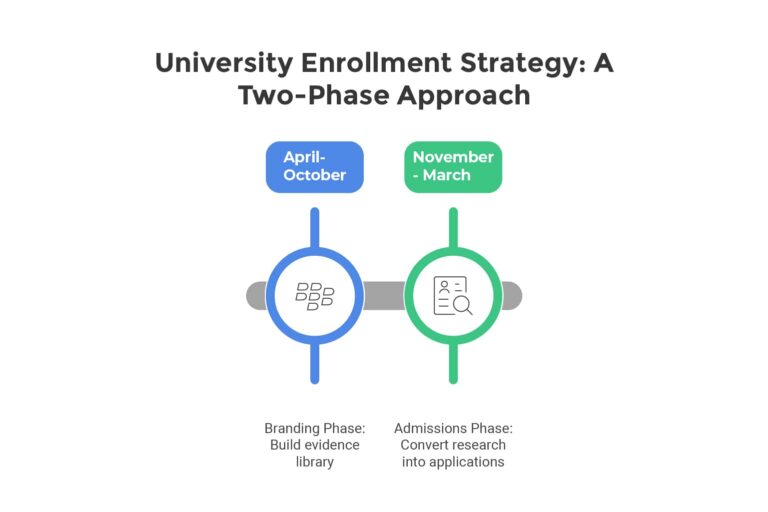
The Two-Phase Strategy
Universities that meet enrollment targets without burning budgets run a different playbook.
Phase 1: Branding Phase (April – October)
Goal: Build the evidence library
Budget: 30% of annual marketing spend
This isn’t an awareness campaign. This is proof creation.
You’re documenting, on video with data, why a student should choose you over competitors. Alumni outcomes. Faculty credentials. Placement records. Campus infrastructure.
The logic: When paid campaigns start in November, students verify your claims. If they find authentic proof created months earlier, trust builds. If they find 2019 data and stock photos, they move on.
This phase loads ammunition. You’re not firing yet. You’re ensuring when you do, you have something credible to say.
Phase 2: Admissions Phase (November – March)
Goal: Convert research into applications
Budget: 70% of annual marketing spend
This is your pure deployment mode. Every ad and email pulls from assets built in Phase 1.
You’re not creating. You’re not waiting for approvals. You’re running proven content through optimized channels and tracking what drives applications.
The logic: Students make decisions between November-February. If you’re still creating content in January, you’ve lost the early deciders, students who apply to multiple universities by the end of January.
The Four Bottlenecks That Destroy ROI
Working with institutions like Amity University and DAU, we see these recurring failures:
Bottleneck 1: Creating Assets During Conversion Window
What happens: The budget gets approved in December, the creative briefing begins in January, shoots are scheduled in February, and the content finally goes live in March.
The cost: By this point, you have already missed November and December, when serious students are actively researching and building their shortlists.
The fix: Lock the content calendar in April, complete all shoots between June and September, and secure approvals by October so that November becomes a month of execution rather than creation.
Bottleneck 2: No Lead Management System
What happens: A student fills out the inquiry form, receives an automated reply, and then hears nothing for a week, by which time they have already applied elsewhere.
The cost: Nearly 40–50% of qualified leads are lost simply due to neglect and delayed follow-up.
The fix: Implement a CRM by September and automate a structured nurturing sequence, Day 2: alumni video, Day 5: faculty profile, Day 8: open house invitation, Day 15: counsellor call, ensuring systematic follow-up while students are actively evaluating options.
Bottleneck 3: Approval Gridlock in Peak Season
What happens: The campaign requires the Dean’s sign-off, but the Dean is traveling, which causes a two-week delay; revisions are then requested, triggering another round of approvals and pushing the launch back by four weeks.
The cost: Late campaigns typically attract only the leftover students who were unable to secure their first-choice institutions.
The fix: Complete all approvals between April and October so that once the admissions phase begins, only pre-approved assets are executed without delays.
Bottleneck 4: Generic Landing Pages
What happens: ₹5 lakh is spent on Google Ads, but the traffic is directed either to the homepage or to outdated 2022 program pages.
The cost: This results in a 35-40% drop in potential conversions.
The fix: Build program-specific landing pages by October that include placement data, strong alumni proof, and a clear, frictionless application path.
What Students Actually Decide Based On
Most universities talk about legacy and campus beauty. Students care, but only after fundamental questions are answered.
Stage 1: Deal-Breakers
- Placement outcomes (average package, placement %, top recruiters)
- Cost vs. ROI (fees vs. starting salary, payback period)
- Location (commutable for parents, industry access for students)
If these don’t meet the threshold, the student eliminates you. Nothing else matters.
Stage 2: Differentiators
- Faculty quality (industry experience + credentials)
- Infrastructure (labs, library, hostel, tech)
- Accreditation (NAAC, NBA, NIRF ranking)
Students use these to narrow 5-6 options to 2-3 choices.
Stage 3: Tiebreakers
- Campus culture (clubs, fests, peer community)
- Alumni network (how active and helpful)
- Brand perception (what current students say)
Emotional factors enter only after rational evaluation.
The expensive mistake: Running Stage 3 messaging (campus fest videos) to Stage 1 audiences who haven’t seen placement data.
Better sequence: Lead with outcomes → Prove capability → Close with community.
How to Execute Each Phase
Branding Phase (April-October):
April-May: Analyze last year’s data. Which programs hit targets? Which missed? Where did students drop off? Research competitors. Survey recent admits, what convinced them to choose you?
This determines content priorities. If MBA underperformed and competitors emphasize placement, your focus is clear: document MBA placement outcomes.
June-September: Coordinate multiple shoots. Capture 15–20 alumni across programs to validate placement outcomes, 10–12 faculty members to demonstrate academic and industry credibility, campus facilities to address parental concerns, and student life content to build emotional connection.
October: Focus on infrastructure setup. Ensure program-specific landing pages are ready, implement the CRM with nurture sequences fully configured, and structure ad campaigns so they are prepared for immediate launch.
Checkpoint: Can you launch admissions campaigns tomorrow without creating anything new? If no, branding phase isn’t done.
Admissions Phase (November-March):
November-December (40% of budget): Students are researching and comparing 10-15 universities. Your goal: get on their shortlist.
Channels:
- Google Search (broad keywords)
- YouTube (alumni testimonials)
- Meta (students + parents)
Metric: qualified inquiries in CRM
January-February (45% of budget): Students are applying to 3-4 universities. Your goal: convert research into applications.
Channels:
- Retargeting engaged visitors
- Search ads for application keywords
- Email sequences
- Open house promotion
Metric: application submissions
March (15% of budget): Late deciders and abandoned applications. Your goal: recovery.
Channels:
- Remarketing to abandons
- Direct counsellor outreach
Metric: final enrollments
Why Open Houses Matter
Students who attend open houses convert at 3-4x higher rates.
The logic: Open house shifts you from “one option among many” to “a real place with real people.” Student meets faculty, sees campus, asks unfiltered questions. Trust accelerates.
Format: 2-3 physical events (December, January, February) + monthly virtual sessions. 90 minutes: campus tour → Dean keynote → faculty interaction → student panel → Q&A.
Follow-up critical: Admissions counsellor contacts every attendee within 3 days. These are warm leads who invested time to visit.
Track What Actually Matters
Most universities track activity (impressions, clicks). It is better to track outcomes.
Three metrics that matter:
Cost per qualified lead: Target ₹300-800 depending on program/geography.
Lead-to-application rate: Target 15-25%. If it is below 15%, follow-up is broken.
Cost per enrollment: Total spend ÷ enrolled students. Only metric that ties marketing to revenue.
Setup: Connect CRM to Google Analytics 4. Track full funnel: ad → landing page → inquiry → application → enrollment. Use UTM parameters on every link. Import conversions to ad platforms (optimize for enrollments, not just leads).
Monthly review: Which programs underperform? Which channels drive the best cost per enrollment? This determines budget reallocation and next year’s priorities.
What to Do Now
If it’s April-October (Branding Phase):
Lock your content calendar, schedule all shoots, and secure early buy-in from the Dean and leadership. Start CRM selection (6-week implementation). Audit website, what needs rebuilding before November?
If it’s November-March (Admissions Phase):
Launch with whatever assets you have. Don’t wait for perfect content. Set up basic lead tracking (capture inquiry source minimum). Plan remaining open houses. They can still recover weak performance.
If it’s post-March (Planning Phase):
Analyze what worked. Which programs met targets? Which channels drove the best cost per enrollment? Document failures, where did students drop off? What content was missing? Build next year’s branding calendar from these insights.
The Decision
The costliest mistake is treating digital marketing as one continuous January-March scramble. Instead of that, take a decision to separate brand-building (April-October) from lead conversion (November-March).
When you build proof first, then deploy during peak decision windows:
- Campaigns perform better (authentic evidence, not rushed content)
- Budget goes further (no premium CPMs while still creating)
- Team executes faster (deploying pre-approved assets, not firefighting)
Most universities will start planning in January. Scramble for content. Miss early deciders. Overspend on recovery. You can choose differently.
The question: will you make that decision now, when there’s time, or in January when you’re already behind?
Socialee has worked with 8 educational institutions across India, including Amity University and DAU.
We build enrollment strategies that separate branding from conversion, implement CRM infrastructure, and track actual cost per admission.