
Have you noticed? Every marketing budget conversation ends the same way.
“Should we spend on brand building or performance campaigns?”
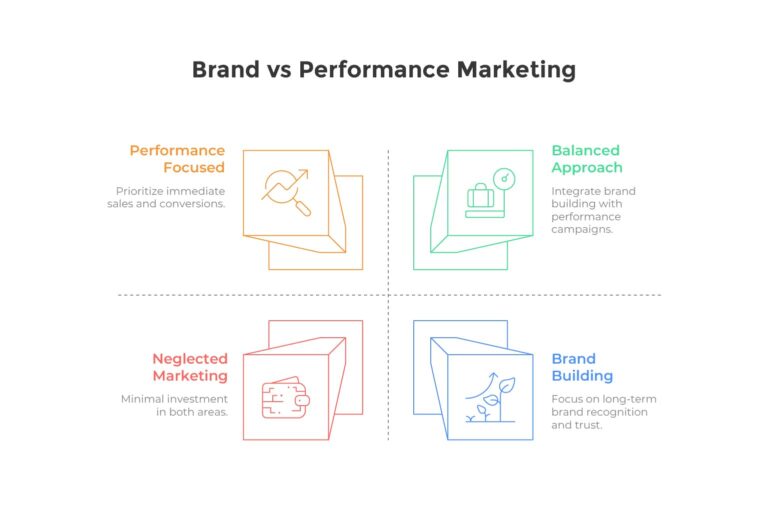
People change, agencies change, but the question remains the same. Surprisingly, the real answer also remains the same; it is both. But not equally, and definitely not at the same time.
After running campaigns across 11 sectors, from healthcare to SaaS to e-commerce, we’ve seen what happens when brands get this balance wrong. You either burn money on ads with no brand equity, or build awareness that never converts.
Here’s how to think about it.
The Actual Difference
Performance Marketing: Designed to trigger immediate action. You run an ad, someone clicks, they buy (or sign up, or download). This is measurable, trackable, and ROI-driven.
Brand Marketing: Designed to build memory structures. You run a campaign, and people remember you exist. When they’re ready to buy (weeks or months later), you’re the first name they think of.
Performance gets you sales today. Brand gets you a preference tomorrow.
The Real Issue Most Brands Face
They treat these as separate budgets. Huge mistake. In reality, they feed each other.
Strong brand marketing makes performance campaigns cheaper. When people already know your name, they click your ads more, trust your landing pages faster, and convert at higher rates.
Strong performance marketing provides data for brand strategy. You learn what messaging works, which audiences respond, what pain points actually drive decisions.
Three Questions Brands Ask (And What Actually Works)
1. “We’re new. If we invest in performance without brand recognition, will it even work?”
Short answer: Yes, but it’s expensive and fragile.
Performance can work for unknown brands if you’re solving an urgent problem or selling at a clear advantage (price, speed, unique feature).
Think about the last time you searched “laptop repair near me” or “birthday cake delivery today.” You probably clicked the first relevant ad, even if you’d never heard of the business. It has high intent and immediate need.
But here’s the trap: without brand marketing, every conversion is a cold start. You’re convincing someone from scratch every single time. No trust shortcut. No repeat preference.
What happens in practice:
We’ve worked with new e-commerce clients who ran performance-only campaigns. Initial CAC (customer acquisition cost) was ₹800. After six months of pure performance with no brand layer, CAC climbed to ₹1,200 for the same audience. Why? Platform saturation. They exhausted warm audiences and had to keep reaching colder ones.
When they added brand content, founder story, behind-the-scenes production, and customer testimonials, CAC stabilized. Performance campaigns started working on broader audiences because people had seen the brand elsewhere.
The approach for new brands:
Start with 70% performance, 30% brand, but the 30% isn’t wasted. It’s compound interest. Use performance to learn what converts. Use brand to make those conversions cheaper over time.
Run conversion-focused ads on Google and Meta (performance) while simultaneously publishing content that establishes credibility, like customer reviews, use cases, founder POV, industry insights, etc.
The performance gets you revenue now. The brand makes next quarter’s performance more efficient.
2. “We’re already a big brand. Why not put everything into performance and maximize ROI?”
Because brand equity is what’s keeping your performance costs low. You’re not paying ₹50 per click because your ads are better. You’re paying ₹50 because people already know who you are, trust you, and are more likely to convert. The moment you stop investing in brand, that advantage starts eroding.
So what happens when big brands cut brand spend:
There’s a lag. Performance looks fine for 6-12 months. Then slowly CAC rises, conversion rates drop, and competitor share grows.
Why? You’re still living off the brand equity you built two years ago. But you’re not refilling the tank. New customers entering the market don’t know you. Existing customers forget why they chose you.
We’ve seen this with established players in education and healthcare. They shifted 90% of the budget to performance thinking, “everyone knows us.” Within a year, their cost-per-lead increased by 35%. Their sales team started hearing, “we went with [competitor] because they seemed more innovative.”
What big brands should actually do:
Flip the script. You can afford to invest more in brand because your performance is already efficient.
Allocation: 60% brand, 40% performance.
Use brand to create distance from competitors. Focus on thought leadership, category education, innovation showcases, culture storytelling, etc. Use performance to capture demand at high-intent moments because brand has already made that demand prefer you.
Big brands that balance this right don’t compete on cost-per-click. They compete on preference. And preference makes every performance rupee work harder.
3. “How do I know when it’s time to invest in brand? What signals should I watch?”
You don’t need to guess. Your performance data will tell you. Here are the specific metrics that scream “you need brand investment now”:
Signal 1: Rising CAC with Same Targeting
If your customer acquisition cost increases 20%+ over two quarters while targeting the same audiences, you’ve saturated your warm market.
Performance is now reaching people who don’t know you. Without brand recognition, they need more convincing which means lower CTR, higher CPC, and worse conversion rates.
What to do: Invest in brand content that introduces you to cold audiences before performance ads hit them. Retarget website visitors with brand storytelling, not just discount codes.
Signal 2: High CTR, Low Conversion Rate
People are clicking your ads (interest is there) but not converting (trust isn’t there). This happens when performance campaigns promise something but your landing page doesn’t have the credibility to back it up.
You’re fighting “I’ve never heard of these guys” skepticism.
What to do: Add brand proof on landing pages like customer logos, testimonials, media mentions, etc. Run parallel brand campaigns showcasing case studies or customer success stories.
We saw this with a SaaS client. CTR was 4.2% (strong). Conversion was 1.8% (weak). After adding customer video testimonials and a “trusted by 500+ companies” section, conversion jumped to 3.4% with no change to ad targeting.
Signal 3: Sales Team Feedback on “We Haven’t Heard of You”
If your sales or customer service teams consistently report that prospects don’t recognize your brand, performance marketing is doing heavy lifting without support.
You’re paying to introduce yourself every single time.
What to do: Invest in LinkedIn thought leadership (for B2B), influencer partnerships (for B2C), or PR/media coverage that puts your name in front of your ICP outside of paid ads.
At Socialee, we worked with a B2B client whose sales team said 60% of discovery calls started with “tell me about your company.” After six months of consistent LinkedIn content from their leadership team and a few industry webinars, the number dropped to 20%. Prospects came to calls already warm.
Signal 4: High Repeat Performance Spend, Low Organic Growth
If 80%+ of your revenue comes from paid channels and organic (direct, referral, branded search) isn’t growing, you have a dependency problem.
The day you pause ads, revenue stops. That’s not a business, that’s rented attention.
What to do: Build brand assets that generate organic demand. Write content that ranks in search. A referral program. Community building. Anything that makes people seek you out, not just respond to your ads.
Signal 5: Competitor Mention in Sales Conversations
If prospects are comparing you to 3-4 other brands they’re also talking to, you’re in a features war. No differentiation.
Brand solves this. It’s not about having better features; it’s about being the obvious choice before features are even compared.
What to do: Invest in brand positioning that creates clear separation. Category creation. Unique POV. Founder-led content. The stuff that makes you memorable, not just comparable.
How Customer Decision-Making Determines Your Split
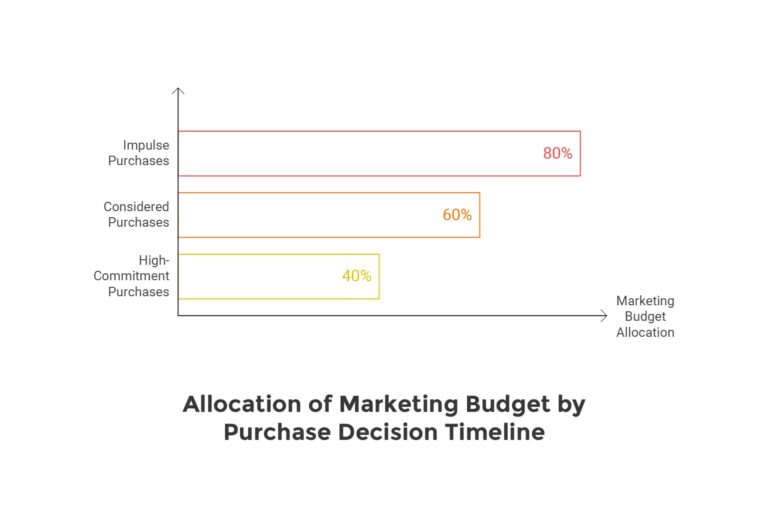
Stop thinking in fixed percentages. Think in decision timelines.
Impulse purchases (under 5 minutes)
Fashion accessories, food delivery, mobile games, and daily essentials.
Allocation: 80% performance, 20% brand
Why: People don’t research. They see it, want it, buy it. You need to be present at the moment of intent. Brand helps with recall when they’re scrolling, but conversion happens on impulse.
Considered purchases (days to weeks)
Electronics, furniture, online courses, premium skincare, etc.
Allocation: 60% performance, 40% brand
Why: People compare options. They read reviews. They ask friends. You need to show up in their research phase (performance) but also be a name they’ve already heard of (brand).
High-commitment purchases (weeks to months)
Healthcare services, education, B2B software, real estate, financial products, etc.
Allocation: 40% performance, 60% brand
Why: People don’t buy the first time they hear about you. Brand builds the trust required to even consider you. Performance captures demand when they’re finally ready.
Sector-Wise Approach
E-Commerce
Split: 70% performance, 30% brand
Example: Google Shopping and Meta retargeting (performance) + influencer partnerships and founder story content (brand).
SaaS / B2B
Split: 50/50
Example: LinkedIn thought leadership and case studies (brand) + demo-focused landing pages and retargeting (performance).
We worked with B2B clients where brand content, like webinars, guides, and customer stories, warmed up leads that performance campaigns converted. One without the other left money on the table.
Healthcare
Split: 40% performance, 60% brand
Example: Doctor profiles, patient education content, community health initiatives (brand) + search ads for specific treatments (performance).
Our work with clients like Zydus Hospitals and Sterling Cancer Hospital showed that brand credibility shortened the consideration phase. Performance campaigns then captured that intent efficiently.
Education
Split: 50/50
Example: Alumni success stories, faculty credentials, campus culture content (brand) + admission deadline campaigns and inquiry form ads (performance).
Gaming / Mobile Apps
Split: 75% performance, 25% brand
Example: Install campaigns with clear CTAs (performance) + community building and influencer gameplay streams (brand).
FMCG
Split: 60% brand, 40% performance
Example: Storytelling campaigns and brand ambassadors (brand) + e-commerce promotions and targeted ads (performance).
The One Thing to Remember
Performance marketing gets you in the game. Brand marketing keeps you there.
New brands can’t skip performance; they need revenue proof. But they also can’t skip brand. They need efficiency over time. The equity they’re coasting on today was built by yesterday’s brand investment. And everyone should watch their metrics. CAC, conversion rates, sales feedback, etc. will tell you when the balance is off.
Not sure where your budget should go? Check your CAC trend over the last two quarters. If it’s rising without targeting changes, you need brand investment now. For more on building marketing strategies that balance short-term results with long-term growth, read: How to Get the Best Out of Your Digital Agency